
Throughout Augusta’s 52 years, we’ve gone through a lot of changes and we’ve offered a lot of workshops. While many people are familiar with our famous music workshops, we’ve also always had interesting craft and folklife workshops. As I spend more and more time in the archive, I’ve come across so many workshops that are both fascinating and amusing. So, I thought I would share my favorite past Augusta workshops, most of which are now sadly extinct. Let me know if you attended these workshops or if you would like to see them return!
Turkey Calling

Photo of a wild turkey (Wikipedia 2025)
First offered in 1979 and taught by Leroy Utt, this Augusta workshop is for aspiring hunters. I’d put this workshop in the strange and interesting, but useful category. Here’s the workshop description from the 1979 catalogue: “Instructor will teach the different sounds that turkeys make and their meanings. Students will make a diaphragm caller and other callers will be demonstrated. Safe hunting rules as pertaining to hunting wild birds will also be discussed.”
Caving

Someone spelunking (iStock 2014)
For those who come to Augusta not for the music, but for the spelunking! Personally, I think we should bring this one back. The caving workshop was first offered in 1980 and taught by James Van Gundy. The catalog advertisement read: “Exploration of area caves as well as geology, folklore and historical importance will be covered. This cave-rich area attracts speleologists from around the nation.” I’m curious to know which caves they explored in this area.
“Weeds for your Needs”

A bunch of dandelions (Gardening Know How)
While we’ve offered a lot of foraging workshops throughout the years, the title of this one caught my eye. Weeds for your Needs first appeared in the 1983 catalogue. Taught by Doug Elliot, this workshop stayed in our catalog for several more years, meaning people must have found a lot of weeds for their needs! Workshop Description: A 2-day tromp through meadows, forests & swamps in search of edible, medicinal & useful wild plants. Will cover how plants are identified, prepared & used. Herbal literature, healing methods & traditional plant folklore will be discussed. One or two day options, specify which one on registration form.
Coopering

Two men coopering (Port Townsend School of Woodworking 2023)
I asked myself when reading through the 1982 catalog, what is coopering? And, after realizing it was the making of casks or barrels, I asked myself: Why is it called coopering? From what I could find, the word coopering is most likely derived from the Latin word, cupa, which means “vat” or “wooden vessel”. Augusta workshops know no bounds. In 1982, Stan Whiting taught this workshop. Workshop goers would “Make a small (1 ½ qt) “piggin” using old-time hand tools, shavehorse & draw-knife. Class includes history of the cooper’s craft–barrel & bucket making–use & care of antique tools & field trip to cut saplings for hoops. Small fee for materials (approx. $10). Making of barrels will also be discussed & films shown.” Now, for the most important question, what do you do with your items after you have mastered coopering?
Native American Week

Photo of Richard Johnny-John from the 1980 Augusta Catalog. Original photo courtesy of the Smithsonian Institution.
I’m jumping a bit forward in time here! Native American Week wasn’t really one workshop, it was a week-long event that offered several different workshops and events with several different instructors. In 1980, we were visited by members of the Seneca tribe of the Iroquois nation. Bill Crouse, Richard Johnny-John, and 6 other members of the Allegany River Indian Dancers taught Augusta students their culture, stories, dances, and other aspects of their life for one exciting week at Augusta. Here’s the description: “This week of immersion in traditional Native American culture will focus on the customs and art forms of a single tribe, the Senecas, of the Iroquois nation. Taught by some of the tribe’s pre-eminent cultural leaders, the class will cover a full range of Seneca culture: dances, songs, rhythm instruments, language, games, stories, legends, clothing, crafts, herbs and herbal medicines, and food. The class is aimed at teachers, musicians, dancers, storytellers, and anyone with a strong interest in Native American culture.” Should we bring this week back? I’m excited to see if I, or another future AmeriCorps, runs into recordings from this week in our archive!
Barn Frame Loom Restoration

Woman using a barn frame loom (Daryl’s Blog 2009)
Do you have a barn frame loom that’s been sitting in your barn gathering dust? Then this highly specific Augusta workshop is just the thing for you! Ok, I’m poking fun, but I do think this workshop sounds very fun and useful for the right audience. I’m curious to see if anyone actually brought their loom or went home and fixed theirs after this workshop. Taught by Rabbit Goody and Stanley Horton in 1992, they advertised the workshop like this: “Barn frame, or timber frame looms are the large structures used by weavers in the 18th and 19th centuries. They can still be found today, restored, and used for weaving. This course offers students an opportunity to learn how to put together and use an old loom. Students will put together several old loom frames, and will learn how to fabricate new parts where needed. Also discussed will be hanging harnesses, warping methods, regional and historical types of looms, and whether to set up the loom using modern technology, or retain the earlier systems of harness and gearing. The class will set up the looms for weaving traditional material, and will weave on these looms. This is a hands-on course, requiring some physical work. Students who have a barn frame loom or an old loom, and wish to bring it to work on, are welcome to do so. Previous weaving experience is helpful but not necessary.” I’ve seen some fixed up barn frame looms in the Beverly Heritage Center, let me know if you have an old one hiding somewhere!
Stone Splitting

Process of stone splitting (Diamach 2023)
At first, I thought that this workshop was for people who wanted to get their anger out by walking into the woods and hitting rocks until they broke. While I still think that would be a fun form of therapy, the stone splitting workshop is likely far more complex. Taught by Jay Sargent, who is described as a farmer, a logger, and a stone bridge builder, it sounded like this class was for people working on farms or wanting to build something out of stone by hand. The 1975 workshop description doesn’t give you much of a clue to the workshop; “Techniques of selecting stones and breaking and splitting them” is all it reads. So, I set out to find what kind of stone splitting would have been taught at Augusta in 1975. According to a stonemasonry website I found, “The history of stone splitting is as old as human culture itself, dating back to when our ancestors first discovered that they could shape and form rocks. This rudimentary knowledge paved the way for the development of more sophisticated and precise techniques, which include the use of wedges and shims” (Diamach 2023). I predict that Jay Sargent taught Augusta students how to split stones using wedges and shims, which sounds like hard work! Sometimes our heritage is found in unlikely places, not just in quilting or old-time music, but in practical crafts like this one. The practice of stone splitting would have been important for early settlers in Appalachia who needed stones to build houses and other structures.
Hornsmithing

Photo of decorated horns in the 1999 Augusta Catalog. Taken by Gerry Milnes
Offered in 1999, hornsmithing blends the Augusta craft workshop with a history lesson. Where else can you learn how to bend a horn to your will and decorate it with beautiful designs. Taught by Roland Cadle, I would have loved to sit in on this workshop. “Students of all levels will serve a mini-apprenticeship to learn the basics of hornsmithing. Using traditional 17th and 18th century technology and tools, participants will explore the mysteries of working with horn, using heat, pressure, and moisture. Considered to be the “first thermoplastic” horn from cows, goats or sheep can be processed using basic hand tools, shaving horses, a treadle lathe, and horn press. Participants will be able to complete one or more projects, such as powder horns, bowls, cups, needle horns, or hornbooks.” I also love all the mysterious tool names like shaving horse and treadle lathe.
West African Appliqué

Photo of Barbara Ward sitting with her masks from the 1991 Augusta Catalog. Photo by Rogier Gregoire.
Uh, COOL! Multimedia artist Barbara Ward first taught this workshop at Augusta in 1991. She has unfortunately passed away, but her art stands as a tribute to how amazing an artist she was. The West African Appliqué workshop introduced Augusta students to a new culture and art form. “A new offering at Augusta, this class will introduce the art of okakagbe, or West African cloth applique, through the making of wearable ceremonial masks. Okakagbe, a multi-media artform utilizing cloth applique, dance and music, was adopted by the Edo of Nigeria. The art is integral to performance in various masquerade functions, and the use of low-relief three-dimensional cloth forms is typical of Nigerian costumes and tribal masks. Students should bring a sewing machine, and be familiar with its use.” I would love to know if anyone attended this workshop and if they still have one of the masks they made!
Log Cabin Construction

Photo of log cabin built by Augusta students from 1985-1987. Photo taken June 11th, 2025.
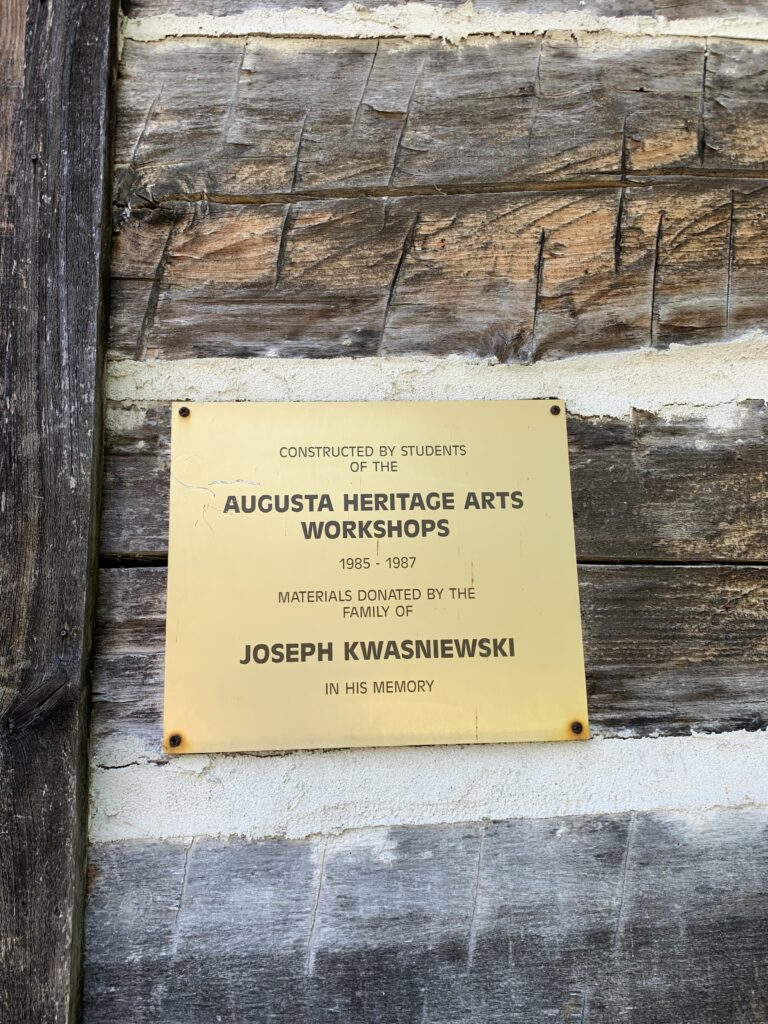
Photo of the plaque on the log cabin.
Last, but certainly not least! I had to include the iconic log cabin workshops in this list. For those of you who don’t know, Augusta students built an impressive log cabin from the years of 1985 to 1987 that is still standing on the campus of Davis & Elkins College today. It is proof that, while some of these wacky workshops and their instructors may be gone, we remember them today. The workshop description says that the, “Class will construct a log building from foundation to roof beams & rafters in a week; size will depend on number of students & experience. Will include use of traditional hand tools & methods of hewing, notching, splitting shingles, etc.; some machine tools, such as chain saws.” The materials were kindly donated by the family of Joseph Kwasniewski in his memory. Taught by Peter Gott, these Augusta students sure accomplished a lot in a few weeks over a few summers!
Well, that’s it! This is certainly not an exhaustive list of all the wonderful workshops Augusta has offered over the years, but I hope it gives you a snapshot of our incredible history. Again, let me know if you attended any of these workshops or have fond memories of workshops that I couldn’t fit into this post!
Works Cited:
- Daryl’s Blog 2009. Earth to Daryl…, weaversew.com, Available on-line: weaversew.com/wordblog/tag/weavers-friend-rug-loom/, Accessed June 12, 2025.
- Diamach 2023. YOUR GUIDE TO STONE SPLITTING USING WEDGES AND SHIMS, Diamach: Stoneworking Tools and Equipment, Available on-line: diamach.com.au/splitting-stone-with-wedges-and-shims/, Accessed June 12, 2025.
- iStock 2014. Narrow cave passage with a cave explorer stock photo, iStock by Getty Images, Available on-line:.istockphoto.com/photo/narrow-cave-passage-with-a-cave-explorer-gm52002440
- Port Townsend School of Woodworking 2023. Coopering, Port Townsend School of Woodworking. Available on-line: ptwoodschool.org/coopering-with-steve-habersetzer-2023, Accessed June 12, 2025.
- Wikipedia 2025. Wild turkey, Wikipedia, Available on-line: en.wikipedia.org/wiki/Wild_turkey, Accessed June 12, 2025.
Madeline Ricks is an AmeriCorps member with the Appalachian Forest National Heritage Area serving at Augusta. She is using her year of service to continue the mission of digitizing Augusta’s large archive, as well as adding to the collection through new recordings and blog posts about Augusta happenings and stories of West Virginia culture. While she was born in Georgia, raised in both Indiana and Montana, and has traveled around the world, she has a special place in her heart for West Virginia, as her mother’s side of the family still lives in Kanawha County. She received her BA in English Literature and a minor in Italian Studies from Gonzaga University and recently finished a Master of Research in Social Anthropology from the University of St Andrews in Scotland. She hopes to leave a lasting, positive impact on the organization and community during her short time at Augusta.