
More great swing tunes will be studied: “Lady Be Good,” “It Don’t Mean a Thing,” “How High the Moon,” and more. Swing evolved harmonically into “Bebop,” in which many of the tunes are built off the changes of swing tunes but with a new melody. It’s become a 12-tone music in that all 12 intervals can be used. The use of chord “substitutions” will be examined and the “turnaround” will be developed to the “tritone substitution.” We will work on the eight-note scales (Bebop Major, Bebop Dominant), as well as the harmonic minor, and Lydian Dominant (Mixolydian with a raised 4th).
Other topics to be addressed during the week are: (1) the mechanics of playing (hand position, what muscles are and aren’t being used) to avoid injury and promote efficient articulation of the notes (make it look like when you play it’s relaxed and easy0, (2) the jobs that your two hands are playing (the right hand dealing with time issues i.e. pocket, feel, groove, etc. and the left hand the harmonic structure), (3) rhythmic tension (how the notes are spaced within a bar) and (4) the shape (bloom) of your notes.
Instructor Bio
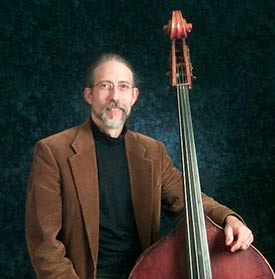
A uniquely versatile musician, Ralph Gordon brings 45 years of musical experience to the bass and cello in the genres of Blues, Swing, Jazz, Klezmer, Folk, Bluegrass, Country, and many others. Classically trained in music studies at West Virginia University and the Manhattan School of Music, Ralph went on to do a stint with the New Jersey Symphony and tour with Fred Waring & The Pennsylvanians. When it comes to knowing and holding down the bottom, Ralph is on top!!! www.RalphGordonMusic.com
check out Gordon and friends at Augusta in 2015 (bass picks up at 1:00):
Will you be available for private lessons?